Fire Alarm Control Panel Parts: Boards, Modules & Power Supplies

A fire alarm control panel is only as dependable as the boards, modules and power components inside its cabinet. Knowing what each part does is the first step toward a correct repair or upgrade. This guide explains the main internal parts of a commercial system, how to recognise which one has failed, what to verify before ordering a replacement, and which compatibility mistakes delay fire alarm projects.

How a Fire Alarm Control Panel Works
The panel is the decision-making centre of a building's life-safety system. It monitors initiating devices such as smoke detectors, heat detectors, duct detectors and manual pull stations, evaluates the signals it receives, and activates notification appliances such as horns and strobes. It also reports trouble conditions, including open wiring, ground faults, low batteries and communication failures, so problems become visible before an emergency exposes them.
A fault in one area can look like a fault in another. A persistent trouble signal may come from a failed power supply, a damaged circuit on the main board, or a single faulty module on the signaling line. Identifying the actual component matters, because the wrong replacement wastes time and leaves the building with an impaired system.
Fire alarm systems in the United States are generally designed, installed and maintained under NFPA 72, the National Fire Alarm and Signaling Code, alongside the requirements of the local authority having jurisdiction. The NFPA 72 code listing describes its scope. Repair work should follow those requirements and be carried out by qualified personnel.
Commercial Fire Alarm Control Panel Parts at a Glance
Most commercial fire alarm control panel parts fall into a handful of functional groups. Layouts differ by manufacturer and model, but the building blocks are consistent.
Main Board and Circuit Boards
The main board holds the processor, memory and circuitry that supervises every connected circuit. It runs the panel's programming and makes the other parts operate as one system. A fire alarm control panel circuit board may also carry terminals for notification appliance circuits, relay outputs and the connection to a communicator. Failures can appear as an unresponsive keypad, lost programming, random resets, or circuits reporting faults when the field wiring tests correctly.
Manufacturers build board families around specific cabinets and firmware, so a board from a different series is rarely a drop-in swap.
Power Supply and Batteries
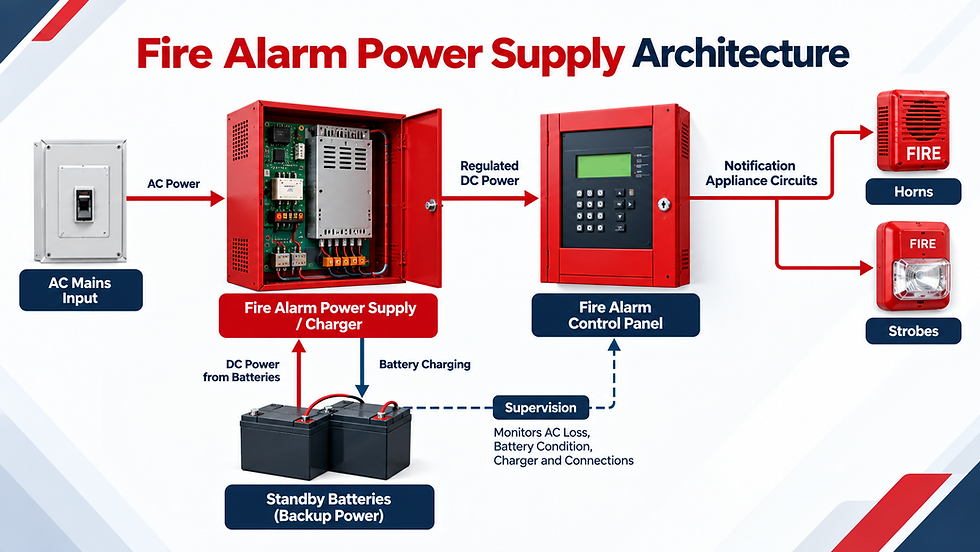
A fire alarm system power supply converts AC mains power into regulated DC power for the panel, detectors and notification circuits, and it charges the standby batteries. When AC power is lost, the batteries carry the system. Typical symptoms of power trouble include AC fail or low battery signals, a charger that does not maintain the batteries, and notification circuits that sag under load.
Batteries age independently of the supply, so test them before concluding the supply has failed. An undersized fire alarm system power supply is also a frequent source of trouble after devices are added to an existing system.
Addressable Modules
Modules extend the panel's reach to devices and functions that do not communicate directly on the signaling line. Addressable fire alarm control panel modules include monitor modules for contacts such as sprinkler flow and tamper switches, control modules for fan shutdown, door release or elevator recall, and isolator modules that protect the loop. Each module has its own address, so the panel identifies it individually, which makes troubleshooting faster than with conventional zones.
Displays, Annunciators and Communicators
The keypad and display present system status to building staff and first responders. Remote annunciators repeat that status at another location, and the communicator sends alarm and trouble signals to a monitoring station. They determine how quickly an alarm is seen and reported.
Fire Alarm Panel Motherboard Replacement: When It Makes Sense
Replacing the main board is the most significant repair on a panel, so it should be the end of a diagnosis rather than the first guess. A fire alarm panel motherboard replacement is generally reasonable when the board shows physical damage such as burned components or water corrosion, will not start with a verified good supply, or repeatedly loses its programming.
Rule out simpler causes first: loose connectors, depleted batteries, ground faults on field wiring, and failed modules pulling down a loop. Measuring supply voltage and checking wiring avoids many unnecessary board changes.
When replacement is necessary, record the panel model, board revision and firmware label, document the existing programming where possible, and confirm the new board suits the cabinet, loop devices and installed options.
Signs a Board or Power Component May Need Replacement
• Trouble signals that return after reset even though the wiring has been checked
• A display that is blank, garbled or unresponsive while verified power is present
• Burn marks, swollen capacitors or corrosion visible on the fire alarm control panel circuit board
• Notification circuits that fail under load although field wiring tests correctly
• Batteries that do not hold a charge even after being replaced with new units
Fire Alarm Control Panel Replacement Parts: What to Verify Before You Order
Choosing fire alarm control panel replacement parts is about matching details rather than names. Many parts look almost identical, yet differences in revision, firmware or protocol can make them incompatible with an existing system.
Pre-Order Checklist
• The manufacturer and exact panel model, taken from the label inside the cabinet
• The part number printed on the board or module, plus any revision marking
• The device protocol used on the loop, since mixing protocol families causes communication problems
• Voltage and current requirements, particularly for power supplies and batteries
• The condition of the part: new in original packaging or refurbished, as clearly described by the seller
• Warranty and return terms
Sourcing fire alarm control panel replacement parts for older panels is harder. Manufacturers retire product lines, and a part missing from a current catalogue may still be available from specialist suppliers. QuickShipFire focuses on this niche and states that its equipment is new in original manufacturer packaging unless clearly labelled otherwise. It is also an independent reseller rather than an authorized distributor of the brands it carries, which is worth noting if your contract or authority having jurisdiction requires authorized sources.
Matching Components to the Building
Fire alarm control panel components for commercial buildings must suit the scale and use of the facility. A small office, a mid-size commercial property and a multi-building campus place different demands on a panel. Point capacity, notification circuits, battery capacity and remote reporting requirements all influence which board, power supply and expansion options are suitable. For a closer look at one popular platform, read the guide on fire alarm control panel components for commercial buildings built around the Fire-Lite ES-50X.
That scale difference is visible in the range itself. QuickShipFire lists the ES-50X as a 50-point addressable system for small commercial buildings and the ES-200X as a 198-point system for mid-size buildings. A property that has outgrown a 50-point panel needs more than extra modules; it may need a different panel entirely. Planning for the future size of the system avoids paying for the same upgrade twice.
Comparing the Main Components
Component | Main role | Common symptom of trouble | Check first | Compatibility concern |
Main board | Processes signals and supervises circuits | Resets, lost programming, false circuit faults | Connectors, supply voltage, wiring | Series, revision and firmware |
Power supply | Powers the panel and charges batteries | AC fail, low battery, voltage sag | Batteries and load | Output rating and panel series |
Addressable module | Connects a device or function to the loop | Missing or duplicate address, loop trouble | Address and wiring | Protocol and device family |
Display or annunciator | Shows status to occupants and responders | Blank or garbled display | Cable connections | Panel model and software version |
Common Mistakes When Replacing Panel Parts
• Ordering a fire alarm control panel circuit board by panel name alone without confirming its revision
• Replacing a board when the real fault is a battery, a ground fault or a module on the loop
• Mixing devices from different protocol families on the same loop
• Skipping a full system retest, including alarm, trouble and supervisory signals and communicator reporting
• Overlooking local requirements, since the authority having jurisdiction may require notification or documentation of the work
Keeping Panel Components Reliable
Scheduled inspection and testing under NFPA 72 catches many failures early. Replace batteries per the manufacturer's guidance, keep cabinets clean and dry, and record the panel configuration. Keep spares of critical items, such as a fire alarm system power supply and common addressable fire alarm control panel modules, to shorten downtime.
Frequently Asked Questions
What parts are inside a fire alarm control panel?
A panel contains a main board, a power supply with standby batteries, addressable or conventional modules, a display or keypad, and usually a communicator for monitoring. The main board processes signals, the power supply keeps everything running, and modules connect field devices to the system.
How do I know if a fire alarm power supply has failed?
Common signs are AC fail or low battery troubles, a charger that cannot maintain the batteries, and notification circuits that weaken under load. Test the batteries and measure output voltage first, because aged batteries often cause the same symptoms. Confirm the diagnosis before replacing the supply.
Can I replace a circuit board with a different model?
Usually not. Boards are designed for specific panel series, cabinets and firmware, so a different model may not connect to the existing loop devices or options. Match the manufacturer, model and part number, and confirm compatibility with the supplier before installing any replacement.
When is fire alarm panel motherboard replacement necessary?
Replace it when diagnosis shows physical damage, a failure to start with a verified good supply, or repeated loss of programming. Check connectors, batteries, grounds and modules first. A qualified technician should confirm the board is at fault and restore the programming afterwards.
What do addressable fire alarm control panel modules do?
Addressable modules connect devices and functions to the signaling line circuit. Monitor modules report contact status, control modules operate equipment such as fan shutdowns or door releases, and isolator modules protect the loop. Each has a unique address, so the panel can identify exactly where a problem is.
Are refurbished fire alarm boards acceptable?
Acceptability depends on your project requirements, the authority having jurisdiction and the seller's warranty. Refurbished boards should be clearly labelled as such, with return and warranty terms stated. For new installations or strict specifications, confirm requirements before choosing refurbished equipment over new.
What information do I need to order replacement parts?
Gather the panel manufacturer and model, the part number and revision on the failed board or module, the loop protocol, and any voltage or current requirements. Photographs of the cabinet label and board markings help a supplier confirm compatibility before the order ships.
Conclusion
Reliable protection depends on understanding how each internal part supports the others. The main board supervises circuits, the power supply and batteries keep the system alive, and modules connect field devices to the loop. Diagnose before replacing, verify model, revision and protocol before ordering, and test the full system afterwards. Treat every fire alarm control panel as a system of matched components rather than a set of interchangeable parts, and choose commercial fire alarm control panel parts that suit the building's size, age and requirements.
If you are repairing or upgrading a panel, collect the model number, part numbers and symptoms before you shop. Browse the relevant QuickShipFire categories or contact the team to confirm compatibility of fire alarm control panel components for commercial buildings, especially older or hard-to-find items.

Comments