Fire Alarm Power Supply: Commercial Systems, Parts & Selection Guide

A fire alarm power supply converts building power into the regulated, filtered direct current that detectors, control panels and notification devices depend on, and it keeps the system running on batteries when mains power fails. This guide explains how the supply works, how it differs from other power components, what codes expect from it, and how to choose or replace one without compatibility surprises.
Power problems are among the most common causes of trouble signals in older installations, and they are easy to misdiagnose. Understanding where the supply sits in the system makes troubleshooting faster and purchasing more accurate.
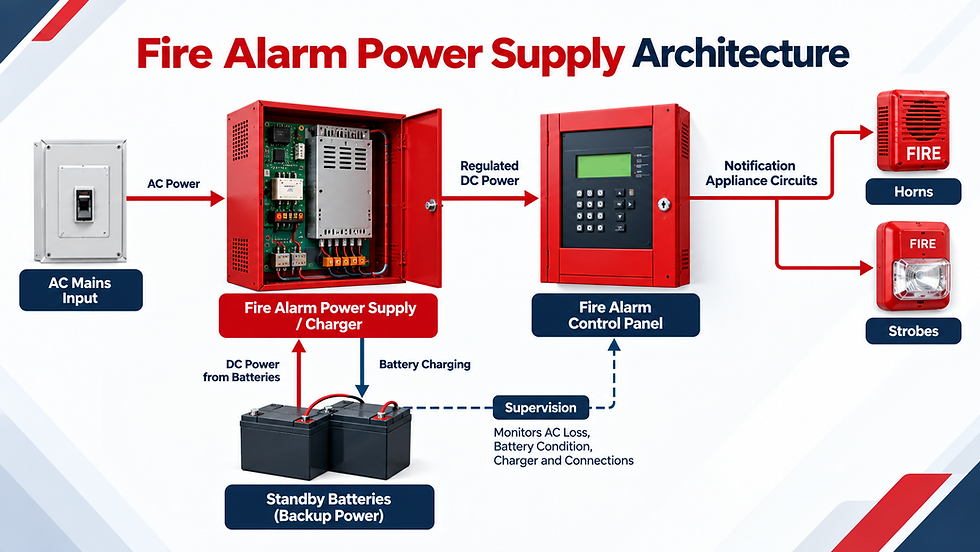
What Does a Fire Alarm Power Supply Do?
It has three jobs. It converts incoming AC power to the low-voltage DC, typically 24 volts, that the system operates on. It charges and maintains standby batteries so protection continues during an outage. It also supplies enough current to sound horns, strobes and speakers when the system goes into alarm.
Because it is life-safety equipment, it is supervised. If AC power disappears, a battery weakens or a connection opens, the panel is designed to report a trouble condition rather than fail silently. That supervision is why replacing a supply with an unsuitable substitute can trigger faults even when the output voltage looks correct.
How a Fire Alarm System Power Supply Is Structured
A fire alarm system power supply is best understood as three layers working together: a primary source, a secondary source and the monitoring that connects them.
Primary and Secondary Sources
The primary source is normally the building's AC supply, delivered through a dedicated circuit. The secondary source is usually rechargeable batteries held in a cabinet beside the panel or booster. When AC fails, the changeover to batteries must happen without losing the system's ability to detect and signal.
Supervision and Trouble Signals
The charger, battery connection and AC input are all monitored. A technician who sees an AC loss or low battery trouble should treat it as a power-system fault first, rather than assuming a detector is at fault. Many repeat service calls start with a battery that was never tested under load.
Fire Alarm Control Panel Power Supply vs Booster Supplies
Most panels include an internal supply sized for the panel's own needs and a limited number of notification circuits. A fire alarm control panel power supply therefore has a fixed capacity, and large buildings with many horns and strobes can exceed it. That is where separate notification power supplies, often called NAC boosters, come in.
Factor | Built-in panel supply | Booster or auxiliary supply |
Primary role | Powers the panel and its circuits | Adds current for notification devices |
Location | Inside the panel cabinet | Near the devices it serves |
Batteries | Panel battery set | Its own battery set or shared arrangement |
Maintenance | Tested with the panel | Separate testing and supervision |
Best suited for | Small to mid-size systems | Large layouts or long wiring runs |
Addressable panels such as the Fire-Lite models in our catalog show how supply capacity is matched to panel size, which is why the panel model should always be known before ordering.
Commercial Fire Alarm Power Supply Requirements
Commercial buildings carry heavier notification loads than homes, so a commercial fire alarm power supply must be selected for the real load, not a rough estimate. NFPA 72, the National Fire Alarm and Signaling Code, sets the standards for power sources, and the capacity commonly cited for protected-premises systems is 24 hours of standby followed by five minutes of alarm. Emergency voice systems and remote-station connections have different expectations, and the adopted code edition and the authority having jurisdiction decide the final requirement. The NFPA 72 standard page is the authoritative reference.
In practice, a commercial fire alarm power supply is sized from the sum of all device currents in standby and in alarm, with a safety margin. Add the loads first, then choose batteries, then confirm the supply can charge them in the required time.
Fire Alarm Backup Power Supply: Batteries and Sizing
A fire alarm backup power supply is only as reliable as its batteries. Sealed rechargeable batteries age, and capacity falls even if the panel shows no trouble. Sizing should cover the maximum standby load for the full standby period, followed by the full alarm load.
Two points are often overlooked. First, adding devices later without recalculating can leave the batteries undersized. Second, the charger must be able to recharge the battery set within the time the code allows. A fire alarm backup power supply that passes a quick voltage check can still fail under alarm load, which is why load testing matters. Technicians use battery test records to spot weak sets early.
Advantages and Disadvantages of Dedicated Power Supplies
Advantages
• A booster adds notification capacity without replacing the entire panel.
• Placing a supply near the devices it feeds can reduce voltage loss over long wiring runs.
• A dedicated unit can be replaced independently when it fails.
• Separate supplies let designers split loads across several circuits for flexibility.
Disadvantages
• Every added supply brings extra batteries, wiring and testing obligations.
• Supervision and synchronization must be configured correctly with the panel.
• Compatibility is limited to the manufacturers and models the panel supports.
• Poor records make a multi-supply system harder to service.
Fire Alarm Power Supply Replacement: What to Check
A fire alarm power supply replacement should begin with identification, not purchasing. Confirm these details before requesting a fire alarm power supply replacement:
• The exact manufacturer and model number printed on the existing unit or panel.
• Whether the unit is a panel board, a booster or a standalone supply.
• Output voltage, current rating and the number of notification circuits served.
• Battery type and the charger's capacity for the installed battery set.
• Whether the replacement carries the listing and labeling required locally.
Make a note of every wire's terminal before disconnecting anything, and take photographs. Fire alarm work must be carried out by qualified personnel under local code, and the system must be tested and documented after the change.
Power Supply Unit vs Power Supply Module
The terms are used loosely in the trade, so clarity helps. A fire alarm power supply unit usually means a self-contained supply in its own enclosure, while a fire alarm power supply module often refers to a board or plug-in component designed for a specific panel. The right choice depends on the manufacturer's design.
When ordering a fire alarm power supply module, confirm that it is designed for your panel, because modules from different families are not interchangeable. A fire alarm power supply unit that is correct for one brand's notification circuits may not match another's synchronization method. If the panel is obsolete, ask a supplier whether an equivalent exists rather than assuming.
A Practical Example
Consider a multi-floor office building where tenants have added partitions and extra strobes over several years. The original panel supply was sized for the first layout, and the batteries were never recalculated. During a power outage test, the system runs normally for a short time and then reports low battery trouble under alarm load. Nothing is wrong with the detectors. The fix is to add up the current of every device, check the battery set against that total, and decide whether a booster is needed to carry the added strobes.
Testing and Maintenance of Power Equipment
Power components need scheduled attention. A fire alarm power supply unit should be inspected for heat discoloration, loose terminals and dust, and a fire alarm power supply module should be checked for secure seating and clean connections. Batteries should be tested under load and dated when installed. Keep a log of every test, because the history shows whether a battery set is declining before it fails.
Common Mistakes to Avoid
• Replacing a supply by voltage alone and ignoring current capacity and supervision.
• Ignoring the batteries when the supply is swapped.
• Sizing for standby load only and forgetting alarm current.
• Mixing equipment from different manufacturers without confirming compatibility.
• Skipping a functional test after the replacement.
Every one of these mistakes is avoidable with a short written checklist and accurate model information. A reliable fire alarm system power supply is the result of careful selection, but a documented test is what proves it. When in doubt about a fire alarm control panel power supply rating, ask the manufacturer or a qualified technician.
Frequently Asked Questions
What does a power supply do in a fire alarm system?
It converts building AC power into regulated low-voltage DC for the panel, detectors and notification devices, and it charges the standby batteries. If mains power fails, the batteries take over so the system continues to detect and signal.
How long must fire alarm batteries last?
For protected-premises systems, NFPA 72 is commonly cited as requiring 24 hours of standby followed by five minutes of alarm. Other system types differ, and the code edition and local authority decide the exact requirement, so confirm before sizing.
Can I use any 24-volt supply with my panel?
No. Voltage is only one factor. Current rating, supervision, battery charging and notification-circuit compatibility also matter, and many panels support only specific supplies. Using an unsuitable unit can cause trouble signals or unreliable alarm performance.
When should I add a booster power supply?
Add one when the notification devices need more current than the panel's built-in supply can provide, or when long wiring runs cause voltage loss. A qualified designer should calculate the loads and confirm the booster is compatible with the panel.
How do I know a power supply needs replacing?
Common signs include repeated AC or battery trouble signals, a charger that cannot maintain batteries, visible damage or overheating, and failed load tests. A technician should confirm the cause, since weak batteries can mimic a failing supply.
Are fire alarm batteries part of the power supply?
They are part of the secondary power source, working with the charger inside the supply or panel. Batteries need testing and periodic replacement even when the supply itself is healthy, so they should be checked whenever a supply is serviced.
Can I replace a power supply myself?
Building owners can identify models and gather information, but fire alarm work should be completed by qualified personnel under local code. The system must be tested and documented afterward, and some jurisdictions require permits or notification to the authority.
Conclusion
A fire alarm power supply is more than a box that delivers voltage. It is the combination of a primary source, battery backup, a charger and supervision that keeps life-safety equipment working when conditions are at their worst. Sizing from real loads, matching the unit to the panel, and testing batteries under load are the habits that prevent most power-related failures.
The practical takeaway is to identify the exact panel and supply model, record the loads, and confirm compatibility before buying anything. If you are sourcing parts for an existing system, review your model numbers and notification loads first, then browse the QuickShipFire power supply range or contact the team to check availability for the units you need.


Comments