True Alarm Photoelectric Sensor: A Complete Commercial Fire Safety Guide

Commercial fire alarm systems live or die on the reliability of their detection devices, and few technologies have proven themselves over as many building types as intelligent photoelectric sensing. The True Alarm photoelectric sensor line, built around Simplex's analog-addressable platform, remains a benchmark for stable, code-compliant smoke detection in offices, hospitals, hotels, and industrial facilities across the United States. This guide covers how the technology works, how it compares to popular Notifier alternatives, and what contractors and facility managers should confirm before specifying it on a project, whether the job is a brand-new installation or a phased retrofit of an aging conventional system. For teams sourcing genuine equipment, the 4098-9601 Simplex TrueAlarm Photoelectric Detector is the natural starting point.
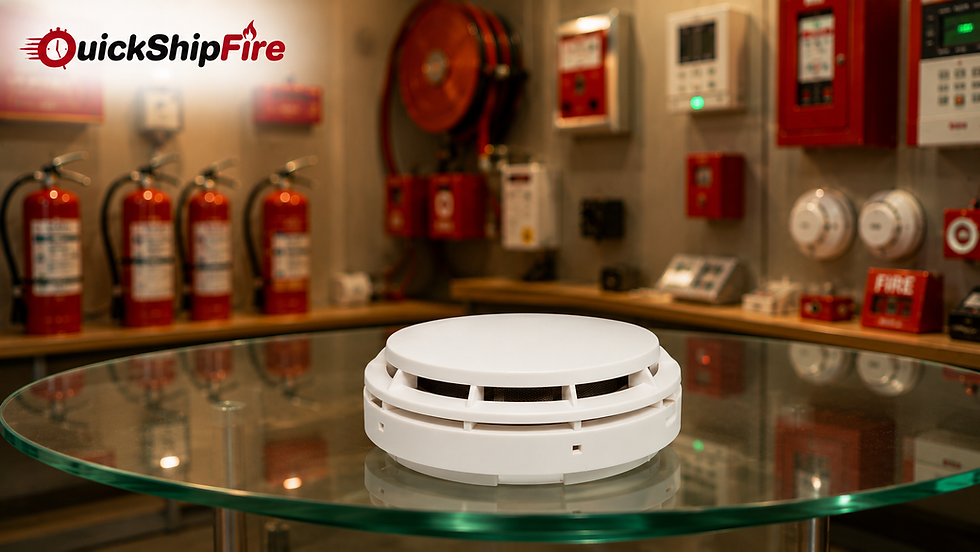
What Is a TrueAlarm Photoelectric Sensor?
A TrueAlarm photoelectric sensor is an intelligent, analog-addressable smoke detection device engineered for Simplex commercial fire alarm systems. Unlike a conventional detector that simply trips a fixed threshold, this sensor continuously reports an analog value back to the panel, allowing the control system to monitor drift, apply adaptive sensitivity, and flag a device for cleaning long before it becomes unreliable. Inside the sensing chamber, a calibrated light source aims a beam at an angle away from a photodetector. Under clean conditions, the beam misses the sensor entirely. When smoke particles enter the chamber, they scatter light onto the detector, and that scattered signal is what triggers an alarm condition at the panel.
This constant communication is what separates analog-addressable detection from older conventional technology. Rather than reporting a simple binary alarm or no-alarm status, the panel receives a continuously updated reading from every device on the loop, which supports both smarter alarm verification and predictive maintenance scheduling.
Why Drift Compensation Matters
Every photoelectric chamber accumulates a small amount of dust and contamination over its service life, which can gradually raise its baseline sensitivity. A TrueAlarm photoelectric sensor compensates for that drift automatically, adjusting its threshold over time so that gradual contamination does not translate into nuisance alarms or, worse, reduced sensitivity to real smoke. When drift reaches a point where compensation is no longer sufficient, the panel flags the device for cleaning or replacement rather than waiting for an outright failure.
This kind of self-monitoring is difficult to overstate in practical terms. A conventional detector gives no warning before it becomes unreliable; it either works or it does not, and the only way to find out is testing or, worse, a real fire. An analog-addressable sensor with drift compensation gives building owners and service technicians a documented trend line, turning what used to be a guessing game into a scheduled maintenance task.
TrueAlarm Photoelectric Sensor in Retrofit Projects
Retrofit work is where the analog-addressable advantage becomes especially visible. Older buildings running conventional detection often need a phased upgrade path rather than a single weekend cutover, and a TrueAlarm photoelectric sensor fits naturally into that kind of project because it reports individually to the panel rather than requiring an entirely new wiring topology. Contractors replacing aging conventional heads floor by floor can bring each area onto the addressable loop incrementally, verifying sensitivity and location reporting as they go rather than committing the whole building to a single commissioning day. This phased approach also gives facility managers a clearer budget picture, since equipment and labor costs can be spread across a fiscal year instead of arriving as one large capital expense.
TrueAlarm Photoelectric Sensor vs. Notifier FSP Detectors
Simplex is not the only manufacturer offering intelligent photoelectric detection, and many buildings run Notifier-based systems instead. Two Notifier models come up constantly in that ecosystem: the FSP-851R Photoelectric Smoke Detector, a long-serving addressable detector still supported on many active installations, and the FSP-951R Photoelectric Smoke Detector, its newer, forward-compatible successor.
The underlying optical principle is similar across all three devices, but the platforms are not interchangeable. A building running a Simplex 4100ES or similar panel needs Simplex's analog-addressable protocol, while a Notifier ONYX-series panel requires FlashScan or CLIP-compatible devices like the FSP-851R Photoelectric Smoke Detector or the FSP-951R Photoelectric Smoke Detector. Choosing between them comes down entirely to which control platform is already installed, not which detector is objectively "better." The table below lays out the practical differences a contractor or facility manager actually needs when deciding what to specify or replace on an existing loop.
Feature Comparison
Feature | TrueAlarm Photoelectric Sensor | FSP-851R Photoelectric Smoke Detector | FSP-951R Photoelectric Smoke Detector |
Manufacturer platform | Simplex analog-addressable | Notifier (legacy addressable) | Notifier (FlashScan) |
Sensing technology | Photoelectric, drift-compensated | Photoelectric | Photoelectric |
Typical panel family | Simplex 4100ES, 4010ES | Notifier ONYX legacy systems | Notifier ONYX, current production |
Manufacturer status | Current production | Discontinued, replace with FSP-951R | Current production |
Common use case | New Simplex installs, retrofits on existing loops | Servicing existing legacy systems | New installs and system upgrades |
Where Intelligent Photoelectric Detection Is Used
Offices and mixed-use commercial buildings rely on this technology for its low nuisance-alarm rate in spaces with variable occupancy and HVAC-driven dust movement. Hospitals depend on the same drift compensation and continuous reporting to keep detection reliable across corridors, equipment rooms, and patient areas where false alarms carry real operational cost. Hotels favor it in corridors and guest rooms because early, reliable smoke detection paired with precise addressable location reporting speeds up staff response during an actual event. Data centers and server rooms often specify photoelectric technology over ionization because it responds well to the slow, smoldering combustion typical of overheating electrical components. Retail chains and warehouse operators managing multiple sites appreciate the standardization benefits as well, since technicians servicing dozens of locations can rely on the same sensitivity programming and testing procedures at every site rather than learning a different device family for each building.
Working on a Simplex system and need a compatible sensor in stock? Order the TrueAlarm Photoelectric Detector directly from QuickShipFire with fast shipping and original manufacturer packaging.
Sensitivity Programming and Point ID
One advantage that carries through every application is panel-side sensitivity programming. Rather than adjusting a physical potentiometer on the device itself, a technician can set and verify sensitivity for each sensor directly from the fire alarm control panel, tailoring detection thresholds to the specific environment, whether that is a dusty mechanical room needing a slightly less sensitive setting or a clean server room where earlier detection is worth prioritizing. Combined with point ID addressing, this gives service teams exact, individual visibility into every device on the loop rather than a zone-level approximation, which speeds up both routine testing and emergency response when seconds matter.
Installation and Base Compatibility
A TrueAlarm photoelectric sensor mounts to a compatible base rather than wiring directly, which simplifies both installation and future service. A few points are worth confirming before ordering:
● Match the sensor head to the correct base type, whether standard, sounder, relay, or isolator, based on the sequence of operations for that location.
● Confirm panel compatibility and firmware version, since older panels sometimes require an update to fully support current sensor models.
● Set the device address correctly, whether through rotary switches or panel-side auto-addressing, depending on the specific installation.
● Avoid mounting near HVAC diffusers, doorways, or other locations with unusually high airflow, which can delay smoke reaching the sensing chamber.
● For duct applications, confirm the sensor head is rated for use in a duct housing rather than assuming any standard head will work in that environment.
● Keep a spare base and sensor head on hand for larger facilities, since a failed device is far easier to swap during business hours than to source on short notice.
A Simple View of the Detection Process
The diagram below outlines the basic optical principle: a light source and photodetector sit at an angle inside the chamber, and only scattered light from smoke particles reaches the detector to trigger an alarm signal.

This simple optical arrangement is the same fundamental principle used across nearly every intelligent photoelectric detector on the market today, regardless of manufacturer. What differentiates one platform from another is not the physics inside the chamber, but the surrounding electronics: how sensitivity is reported, how drift is compensated, and how the device communicates its status back to the control panel over the addressable loop.
Compliance and Testing Requirements
Intelligent photoelectric detectors must meet UL 268 listing requirements, and current-production devices are built to the 7th Edition standard, which includes more rigorous testing against a wider range of fire types than earlier editions. NFPA 72 requires annual functional testing of every initiating device, along with sensitivity verification to confirm the sensor still falls within its listed range. Because analog-addressable devices report a continuous value to the panel, technicians can review historical sensitivity data during testing, which often reveals a device drifting out of range well before it would fail an in-person test, giving building owners time to plan replacement rather than reacting to a failed inspection.
Keeping clear records of sensitivity readings over time also helps during insurance audits and change-of-ownership inspections, where documented, consistent testing history carries real weight with both underwriters and the authority having jurisdiction.
Need to replace an aging photoelectric detector before your next inspection? Browse our full range of smoke detectors or contact our team to confirm compatibility with your existing panel.
Conclusion
Choosing the right intelligent photoelectric detector comes down to matching the device to the control platform already installed, not chasing a single "best" option across brands. A TrueAlarm photoelectric sensor remains the natural choice for Simplex analog-addressable systems, offering drift compensation, continuous reporting, and a long track record across commercial and institutional buildings. For Notifier-based systems, the FSP-851R Photoelectric Smoke Detector and its successor, the FSP-951R Photoelectric Smoke Detector, fill the same role with equally proven reliability. Whichever platform a building runs, the underlying goal is the same: catch smoke early, report it precisely, and keep nuisance alarms to a minimum. For contractors standardizing across a multi-site portfolio, sourcing a consistent TrueAlarm photoelectric sensor lineup from a single reliable supplier also simplifies training, spare-parts inventory, and long-term service planning.
Frequently Asked Questions
What is a TrueAlarm photoelectric sensor used for?
It is an intelligent smoke detection device used in Simplex analog-addressable fire alarm systems. It continuously reports a signal to the panel, supporting drift compensation and precise location identification.
Is a TrueAlarm photoelectric sensor compatible with Notifier panels?
No, it is built specifically for Simplex's analog-addressable protocol. Notifier systems require compatible devices such as the FSP-851R or FSP-951R detector instead.
What is the difference between the FSP-851R and FSP-951R detector models?
The FSP-851R is a legacy model that has been discontinued by the manufacturer, while the FSP-951R is its current, forward-compatible successor. Both use the same core photoelectric sensing principle.
How often should intelligent photoelectric detectors be tested?
NFPA 72 requires functional and sensitivity testing at least once per year. Analog-addressable devices also allow technicians to review historical sensitivity trends between scheduled tests.
Does drift compensation eliminate the need for cleaning?
No, it only adjusts the alarm threshold to account for gradual contamination. The panel will still flag a device for cleaning or replacement once drift exceeds a safe range.
Can a TrueAlarm photoelectric sensor be used in a duct application?
Yes, as long as the specific sensor head and base combination is rated for duct-housing installation. Not every standard sensor head is suited for that environment, so this should be confirmed before ordering.
Where can I buy genuine TrueAlarm and Notifier photoelectric detectors?
QuickShipFire stocks the TrueAlarm Photoelectric Detector along with FSP-851R and FSP-951R detector heads in original manufacturer packaging, with fast shipping across the United States.
Can sensitivity be adjusted without visiting each detector in person?
Yes, sensitivity is programmed and verified through the fire alarm control panel rather than a physical adjustment on the device. This is one of the main advantages of analog-addressable detection over conventional systems.


Comments